Showing posts with label Green Gulch. Show all posts

Saturday, May 26, 2012

Nothing to Write About

That last entry was a complete throwaway, it occurred to me to write out a sesshin blurb in that format, so I did, but my heart wasn't in it. The problem is I'm not sure how to write about what actually happened, or if I should, or if I want to share it with everyone. I'm not trying to be coy (well maybe a little) it's just a hard experience to sort out, the crucible of sesshin can have a dramatic effect on people, even experienced sitters.

The Language Thing

One of the hardest and most compelling parts of sesshin for me is the restrictions on reading and writing. Speech I don't have a problem with, but not being able to read and write was initially terrifying. I work in a world of words and conceptual constructions, formal and informal grammars, ontological structures, inheritance hierarchies, complex networks, directed graphs of nodes. For fun I mostly read, voraciously, online and off. It's not a recognized condition but it's probably fair to say I'm on the hyperlexic side of the curve.

Over the course of the last year or so as I've sat through more than twenty full days of meditation the experience has been varied, but as each new experience has come up I've learned to recognize it and label it and let go. In the classic texts there are 10,000 things that come up durning meditation and the practice is to meet those things, recognize them for what they are and let go of them. Just sit there and process what comes up, be still and simply endure your own inner chaos and learn what it is that drives you to distraction.

It's a slow process, picking apart the sensations, perceptions and conscious formations that arise in our minds and figuring out how not to become attached to them. Thus we relieve all suffering one moment at a time, sitting there on the cushion, soaking it in for a little while. Each new sit has brought me a new piece of knowledge about myself, a way to stop for a moment and recognize particular formation for what it is: delusion. So when I realized that I spend most of my time in mediation, and in life, thinking about what to say, well, it might not sound like much but it made a big difference.

Being Time

I haven't started in on the original writings of Dogen just yet, but there is one phrase that has stuck in my mind since I first heard it: "the mind moves from the present to the past". That is, even though we understand time to be a linear phenomenon, with the clock ticking inexorably forward away from the past and into the future, our experience of it is distinctly non-linear. We visit the past every time we remember a pleasant memory or a regret or a loss, and we travel into the future every time we compose, practice and rehearse what we are going to say or write to someone.

Sitting there, one day it came to me, I'm almost always in the past or the future. Either swimming in an ocean of regret and loss or hanging from a cliff of anxiety, fearful of falling into the uncertain future, grasping at the vines. So I had my moment, my sudden realization that I'd been sitting here out of time most of my life. Living in my own forest of delusion about what may have happened and what might happen. That's when it finally got quiet, the monkey sat down in my lap, right there in my cupped hands, curled up a went to sleep.

Nothing to Say

It's what happened next that I'm not sure what to say about, or if there is anything to say about it. Because what it is required the suspension of language, and how can you describe an experience that is inherently outside of the bounds of language? This is the fundamental koan of Zen, how do you show what cannot be described in words? Many have tried, but the answers tend to frustrate beginners:

"How do you think of not thinking? Think of non-thinking."

"The way that can be told is not the true way."

"The path is the goal."

There are moments that I could describe, but they're just memories, just the worlds I use to remind myself about a past that has already dissolved into emptiness. And there are things I might want to say about the future which doesn't exist outside of my own prognostication. The past and future are products of the persistent delusion we all carry around with us, that we are separate from the rest of the universe, that what we think and experience in day to day life is reality. The truth is far more profound than words can describe and it's highly resistant to being recorded or explained, you have to go looking for it yourself, and you can't stop looking until you find it.

Mission Accomplished?

Going back to the beginning of this blog, a little more than a year ago, I laid out my goals for practice:

"What I hope to learn [is] how to be in the moment with myself and the world. How to let go of my delusions and see clearly, how to step away from my habits and into a spontaneous life."

Even at the time I knew that these gaining ideas weren't quite in line with the teachings, but sometimes you have to go with the best you have. Having a specific goal in practice misses the point of exploring yourself and looking for the present moment. Believing for a second that anything has or can be accomplished in seating meditation is a trap, we don't improve by sitting, we create space in the rest of our lives so that we can improve ourself. It's a subtle distinction but critical to keeping close to the way, which is what is required to actualize the enlightenment that can be touched in Zazen.

Practice, therefore, is just that: practice. The real work of becoming a Buddha—something I never intended to pursue—happens outside of the Zendo, away from the cushion. Practice prepares the ground of awakening, but the seed is already beneath the soil, richly fertilized with our karma and delusions, ready to come up through the ground and grow if we can just let the light in and make room in the garden of our minds.

"Dirt farming and cloud farming, it's all the same."

Thursday, April 19, 2012

Four Truths of Sesshin

One: All of Sesshin is Suffering

From forgetting my Oryoki bowls, to being late to take the refuges, to wake up bell, into hours and hours of sitting, through twenty services and oryoki meals, hundreds of prostrations, soji, dishes… Following the schedule completely is suffering, anyone who tells you differently is selling something.

Medicine Bowl might be the worst, though.

Two: There is a cause for Sesshin

We chant about it in morning service: all my ancient twisted karma; born from beginning-less greed, hate and delusion. Sitting is first and for most an exercise is not generating karma. What karma can accumulate when speech, movement and even thoughts are restrained?

Sesshin is the process of cutting the Gordian knot that we create in our lives, through our actions, speech and thoughts. Just sitting there the past and the future unwind into the present moment, past misdeeds are confronted and desires for the future examined in detail. Sitting puts our karmic life under the microscope and asks us to look at it, to classify it and understand the roots of our suffering.

Three: There is an end of Sesshin

The schedule loops day after day, it becomes a steady rhythm and you move from place to place, ceremony to ceremony, sit to kinhin, back to the cushion, setup for talk, eat lunch, take a break, afternoon sitting, service… The clock ticks through every moment of the week, keeping an eye on the schedules posted around is pretty much mandatory. It's also the only reading you get to do. Savor it.

Six full days of living in a darkened room, staring at a blank wall. But then, on the seventh day, it ends. You have breakfast, a closing talk, lunch and then the sesshin is over. You can talk again. Read. Have a cookie.

OMFB a Cookie.

Four: There is a path to the end of Sesshin

The path has eight steps

    1. Right View - Sure it's painful and exhausting but remember that you're here to have fun.
    2. Right Intention - Just to make it through to the end seems like enough of an intention.
    3. Right Speech - None. Well, as little as possible. Dish shifts are a good place to sneak in a word or two.
    4. Right Action - Do whatever is needed of you in the moment, you might luck out and get to serve tea.
    5. Right Livelihood - Do your soji job well, make it your personal mission to keep your area perfect for the week.
    6. Right Effort - Try not to miss sittings. Try. I signed out for one evening sit on the tenkin pad: "in room crying".
    7. Right Mindfulness - Remember that everyone else around you is going through the same process, give them space.
    8. Right Concentration - Enjoy your zazen. It is the dharma gate of bliss and repose, after all.

Keep these four truths in mind of and follow the eight steps and you might do a little better than just Surviving Sesshin.

Sunday, April 1, 2012

Practice Period Blues

I only have a day to get this written, the sesshin at the end of the spring practice period at Green Gulch starts Sunday evening. We'll take the refuges after dinner and then it's no talking, no reading, no writing, no eye contact for seven days. After the experience last time I'm not sure exactly how this one will go, but since I can sit all seven days I will.


Follow The Schedule Completely

One of the attractions of monastic life, and therefor of participating fully in a practice period, is that you don't have to waste any time thinking about what to do next. There's a schedule, structure, the meals and services run on time, tea is served at a particular hour, bedtime is announced with clackers, the wake up bell is rung each morning by the shousso. There is a correct way to do everything, and a place and time for every ceremony, even just the ceremony of zazen.

Householders do not enjoy such luxury, we are always juggling multiple schedules, constantly adjusting priorities depending on both necessity and preference. Having kids throws in a level of imperative that makes trade offs that were once unthinkable a practical reality: someone may be likable but flawed, and do I have time for that? In that environment, dedicating time to practice and meet regularly with a teacher means cutting more and more discretionary activity out of your life. When I hear people talk about this as a matter of necessity, not preference, I understand what they mean.

These two worlds come into collision when your teacher leads a practice period. Both residents and visitors who have applied to spend a number of weeks on the farm without leaving, and to sit each morning and through two one day sittings and finally a seven day sesshin at the end. This puts immense demands on the teachers time especially having regular practice discussions with everyone who signed up.

It becomes basically impossible to schedule practice discussion, making your best option to sign up for the one-day and seven-day sits. If a practice period is a tour of duty, i'm a reservist: one weekend a month, seven days a year. While is hard to have a regular schedule interrupted, it's important to consider what a rare thing it is to have access to this level of practice as lay practitioners.

The Inside and the Outside

As a lay practitioner, no matter how serious, there will always be a line between being inside the community and being outside. As much as I try to walk across that line on a regular basis, at the end of the day I can go home, have a beer and a burger and there's no Tenzo to tell me different, no Ino to check in with if I want to skip meditation, no Tanto to keep me from using my iPad at the dinner table.

The support system that makes monastic life possible stays right where it is when we go home.
Being at Green Gulch for a day of sitting, or a week of Sheehin, is a step out of day to day living. But it's not a complete step into monastic living, it's something between, a Zen twilight where the people in the outside world don't quite understand what you're up to, but to a certain extent neither do the people inside.

Saturday, March 24, 2012

Playing Dress Up

When I first wandered into Zen Center a little more than a year ago, the robes really took me by surprise. It's not clear what I was expecting, maybe jeans and black shirts? It really was a bit of a shock, and while it's the most obvious example of emulating Japanese dress and culture around here it's only the tip of the iceberg.

Beside the surprise there was some mild aversion: surely the transmission of the subtle secret of Zen doesn't require us to play dress up! I mean really, aren't we passed that? What's wrong with some jeans and a nice button up shirt? Why are all these people wearing those funny looking bibs? And that was at City Center.

Dogen's Temple of Eternal Peace Miniature Play Set

If walking into City Center was a surprise, going up to Green Gulch for the first time was a bit of a shock. If City Center is the shallow end of the pool and Tassajara the deep end, Green Gulch is the middle end. There are a number of long term residents, mostly with families, and a fresh batch of farm and garden interns shows up every few months. Reb keeps his residence there and there are priests in training, making it a monastery as well as an organic farm and retreat center. Many more people wear robes more of the time, the buildings are fashioned in Japanese style, the landscaping is heavy on standing rocks and asian trees. It's basically a full time re-inactment of a Kamakura Period Zen monastery.

There's just one small difference: nearly everyone is caucasian. And while the robes annoyed me a little the paucity of Japanese teachers was genuinely difficult to accept. Surely the transmission of the subtle secret of Zen requires Japanese masters! I really had a hard time getting past it at first and not having done my research ahead of time it was a bit of a surprise.

Suzuki Roshi died in 1971, more than 30 years ago, Katagiri Roshi left to establish the Minnesota Zen Center 1972 and Kobun Chino had moved on to establish Haiku Zen Center in Los Altos in 1970, leaving San Francisco under the abbacy of Richard Baker. The inmates have been running the asylum for a while now.

Theatro Zendo

It was clear to me after my first one-day that what goes on in the zendo is a bit of a play. Ceremonies are scripted actions, the priests and students act out a piece called 'morning meditation' nearly every day of the year. With proscribed roles, scripts handed out for chanting, and some nice soliloquies from the teachers during the day it's hard not to see the place as a theater. The zendo is the stage, the liturgy is the script, ceremonies involve lots of blocking and practice beforehand, we are all just players in the great drama of dharma.

In this light, costuming is just part of setting the stage, no different than building the zendo on the pattern of a Japanese or Chinese meditation hall. It's perfectly natural to want to look the part, it helps to reinforce what is is you're up to, it's a constant reminder to stay in character as a bodhisattva. It shapes identity, one of the reasons we get so attached to the clothes we wear is that they are selected to reinforce and project our ideas of who we are.

Of course, the whole point of Zen is to come to the realization that there is no 'self' or 'other'. So how do we reconcile this? Why build the zendos and wear the robes if zen is about realizing the emptiness of forms? Dogen answers the question in the opening of the Fukanzazengi:
What need is there for concentrated effort? Indeed, the whole body is far beyond the world's dust. Who could believe in a means to brush it clean? It is never apart from one, right where one is. What is the use of going off here and there to practice?

And yet, if there is the slightest discrepancy, the way is as distant as heaven from earth. If the least like or dislike arises, the mind is lost in confusion.
For Dogen, concentrated effort was just sitting zazen, the rest of monastery operations were simply the norms of the time. Modern practitioners are committed to the task of recreating the environment of the founder as well as they can in the modern world. Both to help themselves better understand the mind of Dogen and to provide good conditions for the creation of Buddhas. It's not a reenactment, but part of a continuous daily performance of the exact same play, transmitted down through the Soto lineage and brought over by Suzuzki, Katagiri and Chino Roshis.

But the forms are emptiness, paying them out produces no merit on it's own. It's the wholehearted engagement that makes for a good play, you have to suspend belief for a moment to really get to the heart of the moment, forgetting yourself for a moment and engaging in the practice. Theater allows us to see ourselves in a completely different light, and Zen exploits that human trait to help guide people. Follow the schedule completely, and you'll find that over time, as you practice the role, it becomes easier and easier to play it out in everyday life.

A Cosplay Experiment

Remember back when I got Yoga Pants? There was some resistance, and as the year has stretched out since then the resistance became a sort of dismissive amusement; "Aren't they cute in their fancy robes." Clearly I had to do something… So I bought myself some tabi, which was a good start. Tabi aren't worn much around here except by the priests and in the tea house. Wearing them with those yoga pants and my usual button up shirt was a bit of a contrast, but you know what? My feet were much warmer when sitting, and I found them to very comfortable to wear around the house.

The same shopping trip was actually intended to get Kimono for my daughter and her friend, we organized a children's tea ceremony for a few of the kids and wanted to dress them up appropriately, but it was also my first step into the world of Zen dress up. The girls looked cute and the ceremony (we served cocoa instead of tea) was a lot of fun for them:

IMG 0273

A Tale of Three Contexts

Uniforms are a powerful thing, we associate them with authority and control. Judges wear black robes to project an air of authority, police, fire fighters, military personnel all have recognizable, distinct, uniform styles which quickly communicate their role both to outsiders as well as within the group via more subtle signals such as insignia. Sales of these items are often restricted and it's a crime in most jurisdictions to impersonate an officer.

Thankfully no such restrictions are applied to the traditional Japanese garments worn around casually by some residents. Turns out, you can just go over to Japan Town and pick them up, even in gaijin sizes. One day I finally buckled, Lilly and I were shopping for a new parasol and fan to replace the last two, which had been over-loved a little. There it was, hanging in a rack of various cotton Kimono and other Japanese style garments: the blue jacket and pants combo, in XL. It fit perfectly.

The next day was the first Sunday of the month, Children's Program. Naturally I wanted to show off my new outfit, join in on the re-enactment a little bit, Lilly in her kimono and me in my new Sunday best. I got about what I expected from the residents, more than a few knowing smiles, you can almost hear them thinking, "we got him." What I wasn't expecting was the reaction of outsiders, especially with the addition of the name badge we wear as Children's Program volunteers. Several times during the day people asked me for directions or had questions about Green Gulch, parents asked what we were doing with the kids today: I clearly looked like I knew what I was doing.

The following Saturday I got dressed up again and went to City Center early for Zazen, service, and breakfast. I haven't been around City Center for a few months and there were a number of new faces. I'd also forgotten that there are many fewer people wearing the traditional clothing, the priests are still in robes but I actually felt a bit out of place. Getting in and out of the Buddha hall for service has a very specific form that I've never completely understood, people expect that you know what your doing when you wear the uniform, so I got a couple of corrective glances getting in and out that I probably would have been spared if I was in my usual outfit.

Worse, I started to think I was an authority. During breakfast I started whispering a detail about the serving form to a neighbor, who quickly cut me off. You might think I would have known better but there it was, the impulse to correct someone, or help them, caused me to break the silence and disturb their breakfast.

The next day was a special event in Japan Town, kimono day. There were a number of events and a few people, mostly women, dressed in traditional Japanese dress, mostly kimono. Only a few of us gaijin were brave enough to go wandering around in consume. I got a few funny looks from the maiko in formal dress, chatted with my favorite antiques dealer, had some ramen and went home feeling a little silly but having enjoyed myself.

Once I got home I didn't immediately change into my usual clothes. I stayed in costume, started cleaning up and getting ready for a week with Lilly. I was still playing dress up, not for an audience or to express authority, but to remind myself how I want to behave. To wrap myself in the teachings of Suzuki Roshi and of Dogen Sama and Bodhidharma and the Original Buddha.
Great robe of liberation
Field far beyond form and emptiness
Wearing the Tathagata’s teaching
Saving all beings.

Sunday, February 26, 2012

Just Another One Day

My favorite priest is leading the practice period at Green Gulch this spring so I've signed up for both one day sittings and the Sesshin at the beginning of April which marks the end of the period. I've found myself lamenting the fact that I won't be able to do a full Practice Period for more than ten years, since I have a seven year old and taking three months off from being a dad is basically unthinkable. So, I'll have to make do as a Zen Reservist: one weekend a month, two weeks a year.

Guest Bowls

I had a deadline Friday night at midnight, some work had to be completed and submitted. I also had an aunt visiting from out of town, a doctors appointment and a meeting which I needed to be prepared for. Busy day, lots going on, while I was getting packed for the one day I put my Oryoki set next to the door so I wouldn't forget it.

Around 10PM I finished up and finished getting ready, double checking my reservation I noticed that there wasn't the usual note about the guest house stay. Considering this for a second I packed up a small tent and brought it along, after doing some laundry I finally left the house around 11 PM. Guess what I forgot?

Camping Out

There wasn't an note on the door with my name on it, and I didn't want to bust in at 11:30 and see if there was a room unoccupied I could use for the night and settle up with the office in the morning, besides I hadn't slept out for a while, so I headed down to the beach. Walking through the farm at night with just a crescent moon and the glow of the city over the hills is an experience of sounds and smells (the compost heap is a particularly fragrant spot), the creek babbling along with you on it's way to the ocean, the wind rusting the trees and grasses, the howling of coyote up in the hills, the breath and chewing of the horses outside the bottom gate, the scurrying in the bushes on the path to the beach.

The tent I brought is a bivvy shelter, I can pack it with the mattress and sleeping bag already in and roll them up into a compact bundle that sets up in less than five minutes. The hike down to the beach is about fifteen minutes, so right around midnight I was tucked into bed on Muir Beach, with a great view of the sky and the surf in my ears. Despite that I didn't sleep much, and the first sitting is at five, I had to get up, break camp, hike back and get changed then stash everything back in the car. There was just enough time for coffee.

Wholehearted Sitting
There is a lot of talk about wholehearted practice around here, reminding us that the Way of Zen (and I think any other serious religious practice) demands complete dedication. It's like a marriage, unless you commit to working through the hard times together it's very difficult to make real progress. We see an aspect of this in the Christian tradition of Nuns becoming figuratively married to Christ and wearing bands on their hands.
When we sit on the cushion with the intent of giving ourselves wholly to our own Buddha nature for a day we give up our everyday thinking and engage in examining ourselves so that we can provide support for all brings. It seems like selfish navel gazing but everyone in the zendo is working as hard as they can to improve themselves and help the people around then. Sitting silent and still with that intention is both an welcome break from our daily accumulation of karma and an opportunity to discover how to keep from reacting without first considering the outcomes, which tends to improve the quality of the karma that we do create.

Confession and Repentance
I wasn't very wholehearted in sitting, especially not at Oryoki, which was a bit of a disaster, I neglected to ask the Ino for guest bowls, thinking that the form would the the same as the Saturday morning Oryoki breakfasts at City Center, so there wasn't a tray for whoever came in after me, since I took theirs. I didn't find out about that until after breakfast, which I felt pretty bad about.

There's no setsu, just a paper napkin; a metal spoon, which can be loud against the bowls if you aren't very, very careful; and the chopsticks are very polished lacquer and round, which makes them roll around on the tray and there was no way I could pick up the almonds with them. When we got to the wash cycle I tried to use the paper napkin on the end of the spook as a setsu, which almost works. When it came time to drink the ambrosia I was amused to find that it tasted a lot like paper napkin.

The services felt good to do twice in a day, but I was completely relieved when i was on the morning dish shift. Lunch in the Zendo went better than breakfast, I figured out how to clean with the napkin so that it doesn't end up disintegrating into the cleaning water, made a nice stack of bowls and dropped them off in the kitchen. Took a walk down the farm road for a bit then back for a coffee or two before the afternoon sits started.

Exit Strategy
After tea, there is a short break, I stopped by the office and signed up for the sesshin at the end of the practice period and at that point, already in my jacket, with my car key in my hand, that I knew it was time to go home. My legs were complaining louder and louder as the day progressed, my lack of sleep catching up with me, I pulled a sheet of paper out of my pocket and penciled in a quick note to the Ino, who wasn't at her post in Cloud Hall, stopped to tell the Doshi's Jika just to make sure and got in the car.

I drove across the bridge and into the city, not to my house but directly to Macy's. I needed to buy some sheets and new pillows for the house, having thrown out the old ones the night before. After taking them home and putting them in the washer I called up a friend who had been wanting to talk and went out to dinner. So, in the end, I skipped out on the last three sittings to go shopping, eat fancy food and have drinks with a buddy.

Looks like I'm going to need a little more practice.

Monday, January 16, 2012

The Silence is a Gift

IMG 1162

It's Winter Intensive season at Green Gulch, the staff are getting a break from running retreats, hosting guests and dealing with the lay members coming and going during the week (we try not to get in the way but let's face it, it's their kitchen, we're just visiting). I've missed a couple of Dokusan and Monday night dinner and dishes dates in the last two months and the absence of these regular points of contact is really noticeable. When I went up yesterday for the regular Sunday program, which they are still hosting but without lunch or muffins, the farm was subdued. Residents have been keeping silence for the last few weeks and it's a little like walking in on the middle of a Sesshin, you really don't want to disturb the water.

It made me notice a couple of things; the great gift that silence can be, and the amount of the outside world I tend to carry with me up to the farm.

The Gift of Silence

I've heard people say that the silence at Zen Center makes it difficult to get involved in the community. For a lot of people I'd say that's true, if communicating by voice is all you are comfortable with then the silence can be downright oppressive. There's no way to express yourself, there's no way to find out what people are thinking or intending with their actions. All our normal day to day social rituals break down and you're left with just a few gestures. Basic interactions like getting food are highly ritualized and silent.

I know there have been times during retreats that I've felt like a tiger in a cage, pacing back and forth along the bars thinking about all the things I would love to say if I could just get out there and get my claws into some nice juicy conversation. Not doing so requires restraint, patience with yourself, the willingness to try again after you blurt something out. It's a constant challenge, and what you learn in the process is that we're always communicating with each other in a thousand way other than speech.

A lot of relationships I've had have dissolved around the issue of silence. There are a lot of people who aren't comfortable in quiet, they have to have a TV or radio running, or be talking with someone, or more likely at someone. I have a hard time with those kind of people, I start to feel worn out, exhausted from processing the constant stream of stimulus. Getting back to inner quiet in that kind of environment means constantly swimming up stream against the flow.

Accordingly the people I miss the most are the ones I could be quiet with. Sitting together working for an afternoon, on the beach just staring at the sunset, lying under the stars on a warm night. There are so few moments I can remember where the quiet just roared in my ears, I could hear my heart beating and my breath coming and going, the wind whispers and I know that there's someone else here, hearing that and themselves as well.

The silence isn't always easy, but it's a great gift. Silence is the space we all need in order to see ourselves, it's the antidote to the constant appetite for experience and sensation which is at the bottom of all suffering. Silence is the most fundamental form of restraint, since communication is the fundamental tool of social animals.

Bringing the Outside In

When I walk into this kind of silence it's hard not to notice the noise in my head. In fact a lot of the time I'm at the Farm I catch myself actively trying to stay busy. Working on projects, organizing events, volunteering to help out on Sundays, coming up for dinner and dishes, staying over for Dokusan. There's always an agenda, something to do. Some gaining idea. A distraction.

So, after Reb's talk I stopped to say a few words to a couple of people, decided that a walk to the beach would be nice and spent the rest of the morning on the farm road and the beach, picking up the occasional rock, guiding the occasional Sunday visitor, chatting with someone on the beach. All the while enjoying the sun the sky and the clouds but still somewhere in the outside world most of the time, over the hill, into the future, back to the past, over to an alternate future, down into a dark fantasy, sideways back into the wind and chill of the day.


here I am,

a leaf on the farm road,

dancing in the wind,

under the bright white clouds.


Thursday, September 1, 2011

I Suck at Sesshin

No really, I'm awful. This beginner was in no way prepared going into this, not physically, not emotionally, and it showed. Here's the play-by-play:

Sunday the 21st

Got stuck in traffic on the way in, needed to stop in to the office before they closed to reserve some rooms for an upcoming weekend with some other parents from the children's program. The Tanto made a point of giving me a stern look when the "no electronics" admonishment was read by the Ino, I'd say my reputation proceeds me but I was in the middle of typing out one last email on my phone at the time, so I had it coming.

After orientation some people stuck around for oriyoki instruction, I went to unpack my room and get ready for the week. After dinner in the dining room we had another rest period (which is traditional after eating) then a period of zazen or two and a brief service for chanting the three refuges, the Ino announced the start of sesshin and our week of silence had begun.

Monday the 22nd

I was late to the first morning sit, which was a real issue because not only did I miss the morning greeting, I didn't really know the form for getting into the zendo a little late. Like any other form you follow along as best you can and try not to dwell on it while settling onto the cushion.

We got our week long Soji assignments in the morning: mens bathroom in the residents hall. It's a Soji dream (lots of toilets and urinals) and there was a bit of a race to get to the soji sheet, read the instructions for the toilets, and grab the supplies before someone else. The first day we had too many on the crew, half were supposed to clean the outside men's room, so there were a few moments of "everyone is doing something, what should I clean." Once we had that sorted negotiating turns at toilet cleaning got easier (there were only two of us left) and the rest of the week went quite smoothly.

Some of the participants work in the kitchen during the week, some are on the Oryoki Serving crew, I was on a dish crew Monday, Wednesday, Friday and one shift on Sunday. After a week on the farm and occasionally doing drop-in shifts I know dishes pretty well so this was a welcome break from the sitting and I was able to help out some of the other participants with putting stuff away and other kitchen forms. So my one area of semi-competence durning the week was well outside the Zendo, but at least it's something.

Tuesday the 23rd

By Tuesday morning I was coming to grips with the schedule a bit and discovered a great gift: a noisy neighbor. Remember back at that last one day, when I was fidgeting all over the cushion? Well, it was that all over again except I was on the other side, thankfully I had Shundo's advice to follow: be compassionate, which wasn't hard considering my recent experience. I'd been there and knew how it felt to sit with my own suffering and to feel like I was disturbing the people next to me. In fact, as long as I had this suffering to be compassionate about, I was able to sit very quietly and focus on that. It was much easier than sitting with my own suffering.

After lunch I took a long hike on the break, up Middle Green Gulch trail to the ridge and then back down the fire road past Hope Cottage. I got back just in time to change out my shoes for sandals and get into the Zendo for the afternoon sit, sweaty and well exercised, feeling every breath.
After dinner I took another break for a sauna, the Jisha to the Tanto came in after me and left before me. I should have paid attention to this but I was enjoying the sauna after the hike at lunch break. When I finally did get out and shower off I was a bit alarmed to hear the Han sound out before I was quite dressed. The message of the Han is 'come to the zendo now', I'm sure nobody minded that I got dressed before I did.

Wednesday the 24th

Most guests who aren't working get a break after meals, the dish crew has to report to the kitchen to do the dishes, so we were excused from the sitting periods after breaks. Monday I didn't take all these breaks but Wednesday I did. Schedule fatigue sets in pretty deeply after three days of dawn to dark sitting, having those breaks was nice even if I did feel like I was missing out, or cheating, or something. Most of the break time I spent in the dining room working on my origami and drinking coffee.

During the week Reb would periodically walk around and give posture adjustments, by Wednesday I could at least get into a posture that didn't need much correction when he came around. Of course I went right back to slouching after that, but for a moment there: Passable Posture.

Thursday the 25th

Got up early, around 2AM, went down to the kitchen around 3 and made coffee then went to the zendo and did an hour of sitting in the dark. Wasn't too hard to be the first for the 5AM sit after that, even after taking time to go get a coffee after the wakeup bell started.

I had two practice discussions Thursday, which was a long time to wait to have a conversation with anyone. The character of the two discussions was pretty much the opposite of what I had expected going in, but I did get what I was looking for, even if I wasn't quite prepared for it that early in the morning.

Remember the ocean of suffering I went swimming in last month? Well it's still there and since my noisy neighbor got a doan job I was all out of distractions, compassionate or otherwise. Most of the rest of the day was spent with that ocean behind my eyes, leaking out slowly and quietly (I hope) as I sat on the cushion.

Friday the 26th

Friday morning came and went, I took a walk down to the beach after doing dishes and got back in time for the lecture. While at the beach I noticed a bag that had been there yesterday, I don't know for sure what was in it but judging from the weight I decided not to open it up. Sitting on the bench I noticed a number of cigarette buts on the ground in front of a bench overlooking the ocean. After a moment of disgust at having to clean up after these dirty litterbugs I picked everything up and walked it over to the garbage cans at the parking lot.

My little beach cleanup left me thinking: what an odd mix of intentions these people had, to come to the beach and try to find some peace and then to poison themselves (as an ex-smoker, I totally understand but I had to develop an aversion to help myself quit) and finally defile the beach by leaving their litter behind. By the time I got to the garbage can to drop off my little bag of shit I'd gotten over my disgust and saw that I'm really no different. We're all a mix of intentions and the trick, if you can call it that, is to stop yourself in the moment between though and action, evaluate the intentions that come up and try to pick the best one.

After listing to the lecture I actually worked up the courage to go up to the front and ask a question about my experience on the beach. You can hear the exchange between Reb and this beginner here (it's about eight minutes in total).

Saturday the 27th

While the break for a walk and doing the Q&A was good I spent most of the day Friday in tears again, twice I got up and a tissue that I'd tucked under my shirt fell out onto the Zendo floor. My neighbor was nice enough to point this out both times. During morning Soji I hit my head on a beam while getting my shoes and blurted out "Every God-Dammed Time!" which drew a few mute stares. It's one thing to break the silence while you're doing dishes but another to start swearing before Soji. Clearly I was starting to get worn down.

After cleaning the mens bathroom but before breakfast I asked the Ino if I could go lie down, my legs hurt, I was tired of crying all day long, I wasn't getting enough sleep or food (I'd been taking small portions at meals all week). Going back to my room I fell asleep immediately and had the most lurid dream I can recall having in years. It reminded me of a story about Ananda, from the roll-in to the Surangama Sutra (p.25 in that translation) where Ananda goes out begging and is tempted into a house of ill repute, he's about to loose his virtue when an agent of the Buddha intervenes at the last minute and 'saves' him from the clutches of a low woman.

Waking up from the dream I checked the schedule and clock, looked at myself in the mirror and quickly shaved then returned to the Zendo for lecture. Turns out you're not actually supposed to shave during Sesshin but I had forgotten to bring a hair brush as well and was starting to look like one of the Farm Crew. Sitting through the lecture was easy enough, and I stayed in the Zendo for fast kinhin, i think, and for lunch.

After lunch I walked down to the beach, coming back my fatigue caught up with me, I felt immeasurably lonely walking back, didn't want to sit in the Zendo and cry any longer so I went straight back to my room to hide under the covers for a few hours. I neglected to tell the Ino where I was (this is part of the Sesshin protocol) and after a few missed sits she came up to check on me and ask what was wrong. I offered up some lame excuse about my legs hurting, and got some advice on stretching and taking a walk to the beach.

Good advice, but hardly pertinent to my situation. I guess it's what I get for lying about why I was missing in action. I promised to come back for the evening service, which was going to be a Bhodisatva initiation ceremony for one of Reb's students (the same one, it turns out, that helped me with the chant book way back at that one day sit).

Sunday the 28th

By Sunday I felt like my knees weren't going to make it the whole day, so I decided on skipping oroyki which has become my favorite part of the full day sits, but which is also the longest time you have to sit without a posture adjustment. I felt that the sitting was more important, though having done it getting in and out of the zendo before and after each meal was a bit awkward, so I'm going to either have to start doing yoga (which is popular around the Zen Center for what are quickly becoming obvious reasons) or give up my pride and sit at a table.

During the final Q&A session after the closing lecture we got a demo of Kyosaku technique after one of the other sitters asked for it. It was all I could do not to get up and ask to be next, but after seeing it once there was really no need to get up and reveal myself as a total Masochist.

After the conclusion of the last sitting period in the afternoon I cleaned up my cushion, and headed out to the kitchen for tea and cookies, on the way one of the senior teachers stopped me and asked a seemingly innocuous question, "would you like to know something about our Zendo forms?" Uh-oh.

"Of course!" I responded and was then told that wearing a mala in the Zendo is specifically forbidden, by Dogen himself. Fuck. It really left me wondering: what else am I doing wrong? I'm sure the list is a lot longer than I'd like to think it is.


Sunday, August 28, 2011

Two Peaches

Two peaches in the bowl in the Guest House

One is pure and perfect, ripe and ready to eat

The other is beginning to go, spots of decay and mold

I pick up the pure one, and consider what's left behind

Someone will have to eat that defiled one

Guess the good one is going back in the bowl…

Wednesday, July 20, 2011

Great Faith and Great Courage

When I did my first one day sit, which seems like forever ago, the talk was something about having Great Faith and Great Something, can't quite remember what. I'm gonna go with Courage:

59du.jpg

After having a rough day on Saturday I went up to the farm for the Sunday program and signed up for the Seven Day Sesshin with Reb Anderson. What could possibly go wrong?

Saturday, July 16, 2011

A Week on the Farm: Friday

Friday: Home for a Day

I started this series nearly six months ago and I'm itching to wrap it up. So here's what I remember most about Friday: Swearing at people in traffic.

Yup, before I even got to the Golden Gate Bridge, I clearly remember having a few choice words for someone who wasn't driving quite fast enough for me. One whole week off the road and it took all of five minutes to get right back into rage mode.


IMG 0075

Friday, July 15, 2011

A Week on the Farm: Thursday

Thursday: Back in the Kitchen

By Thursday the daily rhythm of life on the farm starts to settle in. You get up with the wake up bell, sit for two sessions, have morning service, do soji, break for breakfast, and after breakfast is work meeting. At work meeting the Guest Student Manager goes around the circle and checks in with arrivals and departures, senior staff makes announcements, any exceptions to the daily schedule are announced, and there is some time at the end for general announcements.

A Riot at Work Meeting

One morning (to be honest I'm not sure it was Thursday) there was an outbreak of unrest. Durning the general announcement someone mentioned that the internet hadn't been working the last day or two. There was a murmur of agreement around the circle, a low group chorus of disappointment and anxiety over being cut off from the outside world.

Now, even when the Internet is working at the farm there is very little bandwidth available. More than 100 people share a single link that would be embarrassingly slow just five miles away. There are signs all over about restrictions: no downloading movies, no streaming video, strict bandwidth limits are enforced. It's a precious resource here, just over the hill from the bustling heart of silicon valley a small farm and the community of Muir Beach rely on a single commercial backhaul connection which tops out at ~ 3Mb/s.

The lack of bandwidth is one of the reasons I go to the farm, besides the slow internet it's also just outside of the various cellular networks. A hike to the ridge or beach puts you back on the grid but within the confines of the valley you're in an RF free zone (except for the Wi-Fi mesh network used to distribute the meager uplink). For someone who spends their working days on the edge of info-shock, constantly consuming and synthesizing large amounts of information from across the global internet and regurgitating parts of it onto social networks (and blogs!) and gleaning the best bits for personal or professional development, having a quiet space is important, probably necessary, to long term sanity.

But for the residents, especially the children who didn't really decide to live here, having a link to the outside world is probably just as important if not more, than my refuge. I come here to get out of the world for a minute, to turn down the volume on the information cascade I spend my days immersed in. I may have only really realized it but the silence is a gift, and seeing the other side of that makes it clear how profound our relationship with communication is. And for people who've chosen to remove themselves from the world, but who don't live in Tassajara where electronics are strongly discouraged (there's very little power, it's a harsh environment, and aren't you there to get away from that), the thin thread of connection back to family, friends, other practitioners around the world is a critical lifeline.

So, despite sort of enjoying the blackout I offered to help out, but didn't get called into service. Maybe next time… The internet came back later that day and things got back to normal. In the mean time I continue to keep up with current and former residents on Facebook, they're all over it (even the Tanto ;).


IMG 0074

Thursday, July 14, 2011

A Week on the Farm: Wednesday

Wednesday: Pond Cleaning

When they got pond cleaning for their work assignment on Wednesday one of the Guest Students was a little apprehensive about going out on a boat so we swapped she went to help out in the kitchen while I went with the rest of the gang down to the pond to pull up some weeds. To accomplish this we used a small aluminum boat, a raft and some rakes that we borrowed from the Farm Crew. I remembered that there was rain gear in my car (where was that yesterday?) and went to grab it even though the weather was much better and it really wasn't necessary.

Pretty quickly we had a bit of an informal competition going between boats, to see who could rake in more weeds. The recommended technique is to put the rake down in the water and swirl it around, like you're trying to pickup a fork full of spaghetti. After comparing our respective loads at lunch time we were all determined to do better in the afternoon and out harvest the other team. As a Guest Practice Retreatant, I wasn't on the hook to go back and work in the afternoon but they would have been one short to crew the boats and the teams would have been split so there really wasn't much choice, it was for the benefit of all beings, except maybe the weeds.

Rake Overboard

My partner and I were in the small boat, besides the rakes we had oars for getting around, the raft used a bamboo punt stick to navigate and hold it's position. Over the course of the afternoon we drifted apart a bit and worked on different parts of the pond, going where the weeding looked most productive. At one point one of our rakes stuck in the mud and was sticking up out of the muck, we had to paddle over to it to get it back into the boat, bit of a close call.

A few minutes later we heard a commotion from across the pond, so we paddled over to discover that the raft crew had lost a rake in deeper water, and it was nowhere to be found. Remember, these are the farms rakes and we were working with a member of the garden crew, so loosing one was a bit of a big deal, the farmers weren't going to let us forget it if we lost one of their rakes. There was a lot of searching, we pulled up all the weeds in the general area and tried to locate the submerged rake, after about ten minutes the raft crew decided to head back so that one of them could change into something more suitable for swimming.

While they were over at the bank my partner in the boat and I continued to search around, and finally I hit it! Leaning over the front of the boat and probing around with my rake I found the submerged one, it's wooden handle floating off the bottom and the iron rake head keeping it on the pond floor. I tried to reach over, almost flooding the boat in the process, after a few minutes of poking at it the course of action was pretty clear. I stripped out of my rain gear and handed my glasses over to my co-pilot, and with a quick "Shikata ga nai" was over the side and into the pond.

The pond is cold and the water is a bit murky, especially after having been stirred up by all the weed pulling. I hopped in and it was way over my head, after coming back up for air I held onto the boat and searched around with my feet until I had the rake between them and could pull it up. Rake retrieved we paddled back over to the cheering raft crew, not only did we save them a swim the farm crew wouldn't have anything to hold over our heads afterwords.

IMG 0073


Wednesday, July 13, 2011

A Week on the Farm: Tuesday

Tuesday: Composting

As much as I enjoyed working in the kitchen, one of my goals for the week was to get out and do some physical work on the farm. So when we heard that we were going to help with composting on Tuesday I was pretty excited. Even if it was raining a little, and all I had on was my jeans and a light windbreaker.

The task, is to build a layer cake of organic material that will be hot-composted down to organic fertilizer for the farm. The recipe has an adorable mnemonic "Farm Girls Must Sing", each of the letters is an ingredient: Food Waste, Green Waste, Manure and Something else I can't recall. The food waste comes out of buckets, the same we'd been putting our trimmings into during yesterday's kitchen work. Green waste was some cleared brush from a field, which was pitchforked onto the pile. Manure, thankfully, is handled entirely by the tractor, which works from a larger pile and scoops up enough for a layer. The paper towels from the kitchen and bathrooms are composted as well. Durning the composting process the pile is turned several times and heats up high enough to sterilize the pathogens in the manure.

Once the buckets of food waste have been emptied they need to be rinsed, then scrubbed with a brush, and the rinsed again. There were a lot of buckets, and they still had plenty of organic matter in them. Near then end I was so tired that I carelessly dropped the hose. The nozzle landed on the handle and sent an arc of water into the air and directly onto my head. I'd already turned my back and was just thinking, "wow, the rain really picked up, hope it's not long before we head back!" when the farm intern I was working with came over and turned off the rain.

By the time we were finished I was soaking wet, cold, tired and covered with rotten vegetables. The buckets had all been cleaned stacked and loaded into the truck. It was a relief to be excused for lunch and start the hike back up the hill. At the end of the morning, there was a sense of both connection to the kitchen work on Monday and accomplishment at what we had achieved together. The compost pile was taller than any of us and bigger than all of us together.

Sometimes we get so wrapped up in our emotional pain, anxiety and other problematic mental formations that we forget about good old fashioned physical discomfort. Composting in the rain with inadequate gear really clears that up. You get wet, the work is messy and physically demanding, I started out chatty and conversational and ended up quiet and focused on just the task at hand.

IMG 0072


Tuesday, July 12, 2011

A Week on the Farm: Monday

Monday: Kitchen Work

The kitchen is the center of comunity life at Green Gulch, as is the case in pretty much every religious community I've seen. Meals are shared and after the first ten minutes of silence you can start getting to know some of the residents as well as other guests that are staying for various lengths of time. After my last two retreats which were silent, this was a huge difference and a bit of a relief. I've been coming up to green gulch for about six months, and there are pleunty of people I recognize but haven't had an opporunity to talk to. Over the course of the week I made a lot of connections with people in the community over various meals, it's a wonderful moment when you hear the clackers that signal the end of the silent portion of the meal and everyone says good morning to each other all at once.

At any Soto temple the office of head cook is called the Tenzo, and it's a little more than just the executive chef, there is a text dedicated to the work of the Tenzo written by Dogen himself, the Tenzo Kyokun, also meal preperation starts with a small service in the Tenzo's office, with an inscence offering and a few bows by the Tenzo or Fukiten (the Tenzo's deputy, this term may only be used at Zen Center because there is literally one other web page with the words Tenzo and Fukiten on them). Once everyone has bowed in it's off to work, my first day I did some dishes and prepped some lettuce for salad later in the week. We were extra careful to be gentle to the slugs that we found in the lettuce, though they did end up in the compost.

One of the treats of working in the kitchen is that you end up seeing the results of your labour on the dinner table over the course of the week, more than one salad contained ingredients I prepped on Monday. As a beginner you will typically get some rather simple food prep or cleanup work, work periods are fairly quiet times with most communication in the kitchen consisting of the type of warnings you hear in working kitchens everywhere: "right behind you", "open oven", or more often just a quick "knife" as you walk by with any sharp implement. The instructions are to pay close attention to the task at hand, be slow and careful, ask questions if you're not sure where something goes or what the correct way is and most of all, enjoy it.

Stay tuned for the next existing installment: Compost

IMG 0071


Thursday, July 7, 2011

A Week on the Farm

Or, What I did on my Summer Vacation.

It was time for a vacation. I totally could have booked a week in Hawaii and sat out on the beach sipping drinks out of a pineapple and pretending to surf, instead I signed up for a week at Green Gulch: getting up at 4:30 in the morning, scrubbing toilets, building compost piles and cleaning out the pond. Basically, I paid to do work that you can't pay americans to do any more and I had a great time.

If you're planning on staying at Green Gulch there are three choices: You can treat the Guest House or Wheelwright Center as a hotel and rent rooms by the night, or you can sign up as a Guest Student, or a Guest Retreatant. Guest Student and Guest Retreatant both participate in the sitting schedule, staring at 5 in the morning, and both have work assignments. Retreatants are given the afternoon off and get a private room. I signed up for the week as a retreatant and stayed in the Guest House as well as a couple of nights in the Wheelwright Center with my daughter over the weekend.

Sunday night I packed up and drove over the bridge, got in around eight in the evening and took a walk down to the beach just after sunset:

IMG 0059

The morning schedule is the same every day: up before dawn, Zazen, Kinhin, more Zazen, Service, Soji then Breakfast in the dining room. After Breakfast there's a work meeting and as a Guest Retreatant you get your work assignment for the day from the Guest Student Manager and spend the morning helping with various aspects of running the farm.

The work assignments sort of make the day, and for each day of the week I'm writing up a seperate self contained entries. Here's the list, which I'll update with links as they're posted:

Monday: Kitchen Work

Tuesday: Composting

Wednesday: Pond Cleaning

Tursday: Back in the Kitchen

Friday: Home for a Day

Friday, May 27, 2011

1-Day Sitting Schedule: Annotated Version

4:35 Wake-up Bell ends - Someone in the guest house had already made coffee, for which I am very grateful

4:50 1st Bell - Yes, 4:50AM, head to the zendo immediately, try to find the right door, in the dark

5:00 SITTING - In the dark, watching the zendo get lighter slowly

5:40 Walking - So very slowly, one step at a time

5:50 SITTING - more light coming in, more awake after the walk

6:30 Morning Service - we're chanting what now? on which page?

7:00 Soji (temple cleaning) - stayed behind for breakfast instruction

7:20 BREAKFAST - went okay, missed the wash cycle

8:15 Rest - no meditating after you eat

9:00 1st Bell- back to it

9:10 SITTING - getting the hang of this

9:50 Set up for Talk - turns out you're not supposed to stack the seat-thingys

10:00 DHARMA TALK - "you may be wondering, what did I sign up for?" well, now that you mention it…

11:10 Walking - fast, on a loop through the zendo and out alongside the pond, saw a blue heron in the yard being harassed by a red-winged blackbird

11:20 SITTING - did I just see that?

12:00 Noon Service - still needed help with the chant book

12:15 LUNCH - achievement unlocked: clean your bowl

1:10 Rest - almost an hour, but no talking, reading or writing

2:00 1st Bell - back in the box

2:10 SITTING- support cushions, how do they work?

2:40 Walking - sweet relief

2:50 SITTING - support cushions really working

3:20 TEA - and COOKIE! OMFB a cookie

3:45 Rest - legs really need a stretch, nice to be outside

4:00 1st Bell - OK almost there

4:10 SITTING - support cushions helping

4:35 Walking - so very slowly

4:45 SITTING - who let the monkey in here?

5:10 Walking - only one session left, almost there

5:20 SITTING - can't really feel legs anymore

5:50 Evening Service - actually found the chants by myself

6:00 DINNER (in dining room) - thanks, but i really need to get in my car and put on some loud music now

Monday, May 9, 2011

Awkward, Confused, Overcome

If I had to pick three words for how it felt to do a full day meditation retreat for the first time, those are the three.

I'm a big fan of Socially Awkward Penguin, for me it's some of the most relatablehumor out there. So when you come back from there, imagine someone who thinks of themselves as a little awkward to start with in situation with strict formal rules and traditions, all infused with deep significance, from a culture that is not your own. I felt like I was constantly making errors, because I was, every little thing has a right way and a wrong way: which side of the cushion to be on, which mudra, facing which direction relative to the assembly or your cushion. The inside of the zendo is a highly scripted performance, and you can't spectate, excepting by reading accounts, so participating for the first time is bound to be awkward.

The three chanting services provided the most confusing part of the day, some ofthe content is phonetically transcribed japanese, some is english, some may be phonetic pali, i'm not sure. There's an announcer who reads the titles before you chant them but if you don't know that and you look clueless enough the teachers assistant turns the pages for you the first couple of times. I figured it out by the last service. A lot of the smaller verses, especially at meal time, don't get announced so if you're a regular, memorization is key for those.

Breakfast and lunch in the zendo turned out to be a treat, I was focused on the forms and followed along pretty well for breakfast, but missed the wash water and had not perfectly clean dishes for lunch. The kit includes a little spatula for 'licking' the bowl in a dignified manner, to make sure you get everything out of the meal. The wash water is you beverage for that meal, drink about a third as part of the ceremony, drain about a third into the buckets, and save the last portion to drink after. I dumped all my water after drinking a small portion and didn't have enough for the toast after wards. The food was really excellent, simple hearty, portions just right for a light day of sitting and walking.

At the end of the day I left before dinner, feeling a little overcome at the scale of the thing. After years of on and off solo mediation this is a bit like running a marathon both in terns of the physical demands of sitting for more than 12 hours and the demands on concentration and focus. Thankfully, there are slow and fast walking breaks built into the program, which help to ease the physical strain of sitting. I tried to stay in the zendo as much as possible and follow along, there was a lot of helpful correction along the way as well as good examples sitting all around you, especially during the meals you can sort of follow along for the most part.

What goes on in the zendo is a highly choreographed experience, with the goal being to break you completely out of your everyday mind and absorb it into contemplation of the present moment. The forms force you out of habit and daily convention and into strictly stereotyped roles, it removes a few of the 10,000 things that come up in our minds moment to moment so that we can see more clearly into the murky water of the self. For me, as a beginner, it was Monkey Mind all day long, swinging from the rafters of the zendo while I sat still as a stone.
So after all that, what could have possibly been worth the physical pain, the anxiety, the otherworldliness of it all? Not sure I have an answer to that but I'm seriously considering the upcoming 3 Day Sesshin at City Center next month.

Contemplating a full day of contemplation

I signed up for a full day meditation retreat at Green Gulch Farm, I'll be staying overnight in consideration of the schedule starting at 4:35 AM. There are nine periods of sitting meditation with some walking, service, dharma talks and eating in between. Each sitting period is at least 40 minutes, which makes for a pretty full day of staring at a wall.

In preparation I've been reading specific sections from D.T. Suzuki's, An Introduction to Zen Buddhism, which includes a detailed description of the most anxiety inducing part of the day: BREAKFAST. It's right there in the schedule, in ALL CAPS. For good reason, breakfast in the zendo is no idle affair. First, you'll need the special bowls:

The bowls which each brings are made of wood or paper and are well lacquered, the are usually four of five in number and fit into on another like a nest.

There's an entire hand gesture protocol for getting more rice once you've finished your first helping, apparently you need to be able to negotiate this in order to get a reasonable meal in the zendo:

When another bowl of rice is wanted, the monk holds out his folded hands, the waiter notices it and sits with the rice receptacle before the hungry one; the latter take up his bowl, lightly passes his hand around the bottom to wipe off whatever dirt may have attached itself and be likely to soil the hand of the waiter.

Once you've gone through this process three of four times, it's time to do the dishes. No getting up and going to the kitchen from the zendo though, you'll be washing up right where you are:

…the waiters bring hot water; each monk fills his larges bowl with it and in it all the other bowls are neatly washed and wiped with the tiny napkin which is carried by him. Then a wooden pail goes around to receive the slop

I'll apparently need a tiny napkin, really should be keeping a list. This description completely explains the hesitation in the voice of the guy taking my reservation "it's your first time? You should really consider the tray, it's much simpler…"

Buddha's Birthday: Green Gulch Farm Edition

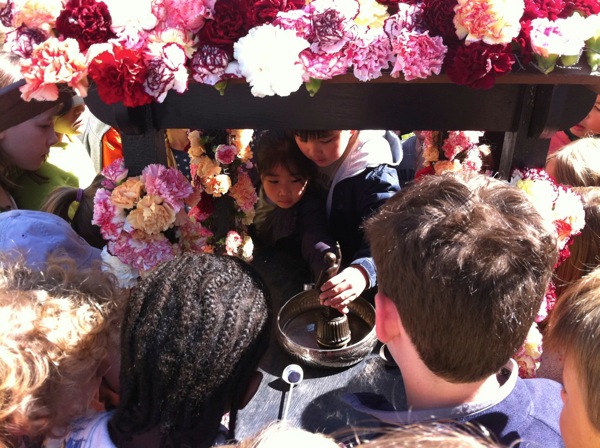
I posted previously about Buddha’s Birthday celebration at San Francisco Zen Center’s City Center. It was my first time seeing the pageantry and hearing the story of Buddha’s birth, my first time chanting the heart sutra, all together a good introduction for the celebration at Green Gulch Farm.

Green Gulch Farm is a very different place than the City Center, it's just over the hill from Mill Valley on CA 1, tucked into a valley above Muir Beach. It's wonderfully accessible from San Francisco and really feels like you are in a different world. Just walking onto the property always makes me feel more relaxed and in the moment.

Every sunday they have a public program, including Zazen, a Dharma Talk and tea, similar to the Saturday program at the City Center. On the first Sunday of the month there is a children's program, which i have been taking Lilly, my 6 year old daughter to for the past four months. The last few months they have been making duck masks and practicing for the duck dance in the Buddha's Birthday celebration which was this past Sunday, May 1st.

Quite by accident I got involved in the Pageant this year and signed up as the duck manager—you have to be careful who you offer to help carry art supplies back to their car, they might be looking for 'volunteers'—and got to experience the celebration from the other side, as compared to my experience as a spectator at City Center a few weeks before.

Rehearsal on Saturday was a lot of work, but it was also a great opportunity to meet some long time members of the community and enjoy Green Gulch on a beautiful sunny day. Being duck wrangler was a lot of fun, the kids where a real treat to hang out with and seeing a dozen of them looking up at you from behind little duck masks before you go on stage, well, it's hard to beat that.

IMG 0921

IMG 0915